By Dr. Hitesh Gupta, Consultant Occupational Therapist & Dysphagia Rehabilitation Specialist
Hitesh(H)-HEALS Physiotherapy, OT & Cancer Rehab Centre, Sector 43, Faridabad
The day the oncologist says the treatment is complete is supposed to be the good day.
For a great many of our patients, it is the day the second problem begins. The tumour is gone. But the mouth will not open past two fingers. Water goes down the wrong way. The right shoulder will not lift high enough to reach a shelf. Speech is understood by family but not by strangers. Weight is falling. And in most discharge conversations, nobody has mentioned rehabilitation at all.
India carries roughly a third of the world’s oral cancer burden, and cancer of the oral cavity is the most common cancer among Indian men. We have become genuinely good at removing these tumours. We have been much slower to rebuild the people they were removed from.
That rebuilding is a clinical discipline in its own right, and it works. This article sets out what can be restored, in what order, and — the part that matters most — when it should start.
Why oral cancer rehabilitation is a speciality, not an add-on
A patient recovering from a knee replacement has one problem in one joint.
A patient recovering from mouth cancer treatment has, very often, several at once: a reconstructed tongue, a stiffening jaw, a numb and weak shoulder, a swollen neck, reduced saliva, altered taste, a feeding tube, profound fatigue, and a face they do not entirely recognise. These interact. Fatigue undermines exercise. A stiff jaw prevents proper dental care. Poor dental care raises the risk of osteoradionecrosis. Reduced saliva makes swallowing harder, which reduces intake, which worsens fatigue.
Treating any one of these in isolation misses the point. Oral cancer rehabilitation means treating the whole system, in sequence, over a period of months — and knowing which problems close a window if they are left too long. Our full cancer rehabilitation programme is built around exactly this whole-system approach.
What the treatment does — and what we rebuild
Understanding the cause makes the therapy make sense.
Surgery. A partial or total glossectomy alters the tongue that shapes food and speech. A mandibulectomy changes the jaw. Free flap reconstruction — commonly radial forearm or fibula — restores tissue but with skin that has no fine sensation and does not move like the tongue it replaced. Neck dissection removes lymph nodes, and in doing so places the spinal accessory nerve under traction.
Radiotherapy. Radiation controls disease but leaves fibrosis behind. Fibrosis is progressive: tissue tightens over months and years, and can worsen long after the last session. It stiffens the jaw muscles, the neck, the throat and the swallowing musculature. It also damages salivary glands, producing dry mouth that changes eating and dental health permanently.
Chemotherapy. Adds fatigue, deconditioning, mucositis and sometimes peripheral neuropathy.
Rehabilitation does not undo any of this. What it does is preserve the range, strength and coordination that fibrosis and disuse are quietly taking away — which is why timing matters more here than in almost any other area of rehab.
The six problems we treat after oral cancer
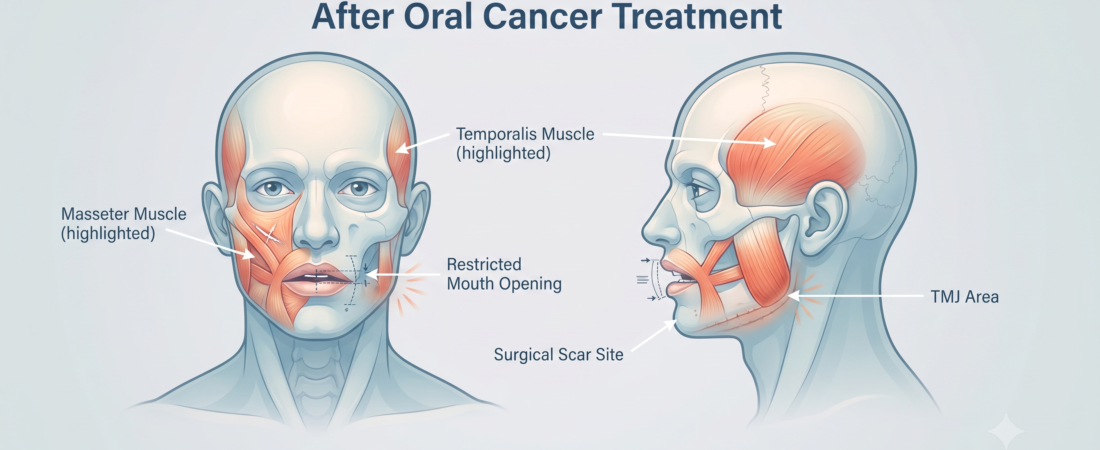
1. Trismus — the mouth that will not open
Normal adult mouth opening is roughly 40–55 mm between the incisors. Below about 35 mm is classified as trismus, and it is one of the most common and most disabling late effects of oral cancer treatment.
It affects everything: eating, speaking, dental examination, cleaning the back teeth, and even the ability to be examined for recurrence.
Trismus responds far better to early, consistent stretching than to late intervention, because mature fibrous tissue is much harder to lengthen than tissue that is still remodelling. Treatment involves measured baseline opening, graded passive and active stretching, stacked tongue-depressor or dynamic jaw-mobilisation devices, myofascial release to the masseter and pterygoid muscles, and a short daily home programme. We measure in millimetres at every visit, because progress here is slow and invisible without a ruler.
For the full self-measurement method and a graded home stretching programme, see our detailed guide: Trismus After Radiotherapy: How to Measure and Improve Your Mouth Opening at Home.
2. Swallowing difficulty (dysphagia)
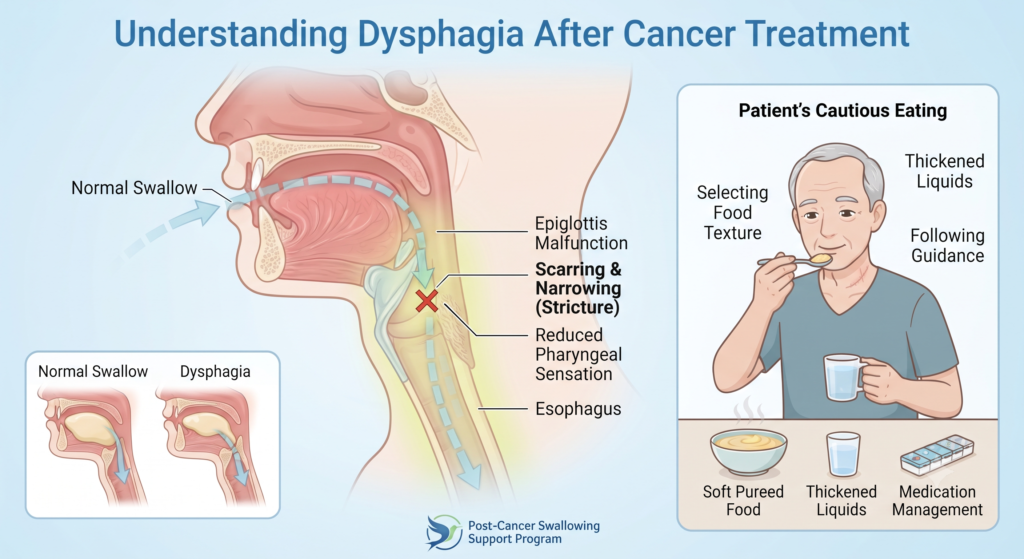
After glossectomy or flap reconstruction, the mechanics of moving food to the back of the mouth are altered. After radiation, the throat muscles weaken and stiffen. Patients cough on thin liquids, feel food sticking, take an hour over a meal, or aspirate silently — food entering the airway without triggering a cough at all.
Therapy combines targeted strengthening (effortful swallow, Masako manoeuvre, Shaker head-lift, Mendelsohn manoeuvre, lingual resistance, expiratory muscle strength training) with safe positioning strategies and correctly graded food textures using the international IDDSI framework. Where the picture is unclear we arrange an instrumental assessment — FEES or a videofluoroscopic swallow study — with ENT and radiology colleagues, because a clinician who never looks inside is working partly blind. Our swallowing and feeding intervention programme is built specifically around this recovery process.
3. Shoulder and neck dysfunction after neck dissection
This one surprises patients, and it should not.
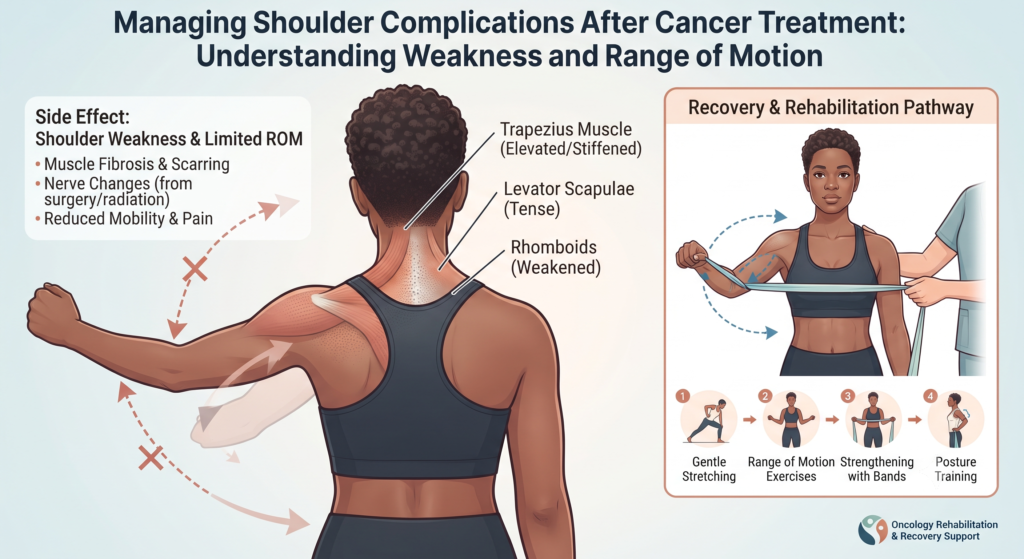
The spinal accessory nerve supplies the trapezius muscle, and it runs directly through the neck dissection field. Even in nerve-sparing procedures, traction on that nerve is common. The result is trapezius weakness, a dropped shoulder, difficulty lifting the arm above shoulder height, winging of the shoulder blade, aching neck pain, and — if left alone — a frozen shoulder on top of it all.
Patients often assume this is unrelated to their cancer or that it is simply how things are now. It is neither. Progressive resistance exercise, scapular stabilisation work, postural retraining and range-of-motion therapy have good evidence behind them, delivered through physiotherapy for the shoulder and neck. Started early, this is one of the most rewarding parts of head and neck rehabilitation.
4. Head and neck lymphedema
Removing lymph nodes and irradiating the neck disrupts lymphatic drainage. Swelling appears under the chin, in the face, or internally in the throat and larynx — where it is invisible from outside but interferes directly with swallowing and voice.
This is badly under-recognised in India, and it is treatable: manual lymphatic drainage, compression, specific exercise, skin care, and teaching the patient to self-manage long term.
5. Speech and articulation
A reconstructed tongue moves differently. Precision suffers before intelligibility does. Structured articulation and oro-motor work, adapted to the patient’s actual post-surgical anatomy rather than a textbook one, recovers a great deal through targeted occupational therapy — and is the difference between being understood at home and being understood at the bank.
6. Fatigue, deconditioning and the donor site
Cancer-related fatigue is not ordinary tiredness and it does not resolve with rest. The evidence-based treatment is graded exercise, which is exactly the opposite of what exhausted patients expect to hear.
We also rehabilitate the forgotten limb: a radial forearm flap leaves wrist and hand stiffness; a fibula flap affects ankle stability and walking. These donor sites are rarely mentioned at discharge and respond well to occupational therapy.
The rehabilitation timeline
Phase 1 — Prehabilitation, before treatment starts
This is the phase almost everyone misses, and it is the highest-value one.
Before surgery or radiotherapy we record baseline mouth opening, swallowing function, shoulder range, weight and general fitness. We teach the exercises the patient will need afterwards while they are still able to perform them easily, and we explain what is coming. Patients who arrive at radiotherapy already knowing their swallowing programme do measurably better than patients handed a leaflet afterwards.
Phase 2 — During radiotherapy and chemotherapy
The governing principle is use it or lose it. Continuing to swallow — even small amounts, even when it is uncomfortable — through chemoradiation is associated with less long-term feeding tube dependence and lower rates of throat narrowing. Patients who stop swallowing entirely for six weeks often find the ability does not simply return.
During this phase we maintain gentle swallowing exercises, begin jaw stretching before stiffness sets in, protect shoulder range, and support oral hygiene through mucositis.
Phase 3 — Early post-operative, weeks 0 to 6
Scar mobilisation, gentle neck and shoulder range within surgical precautions, oral hygiene, positioning, and the first steps of a return to oral intake in coordination with the surgical team.
Phase 4 — Restorative, months 2 to 6
The main strengthening phase. Progressive resistance for the shoulder, structured trismus stretching, swallowing rehabilitation, lymphedema management, articulation work, graded return to normal activity and to work.
Phase 5 — Long-term surveillance, one year and beyond
Radiation fibrosis is progressive. Mouth opening, swallowing and neck mobility should be re-measured periodically for years, not weeks. A patient who was fine at twelve months can develop significant trismus at thirty. Late-onset problems are common, recognised, and treatable — and catching them early is far easier than reversing them.
Coming off the feeding tube
Many patients are discharged with a nasogastric or PEG tube and are told, vaguely, that it may come out “later.”
Weaning is an active clinical process, not a waiting game. It requires assessment of current swallowing safety, graded reintroduction of textures, monitoring of weight and hydration so that reduction is safe, and close work with the treating team. Many patients who have been told they will be tube-dependent indefinitely return to full oral intake with structured therapy. Some do not — and for them, safe comfort feeding and quality of life become the goal. Both are legitimate outcomes. Neither happens by itself.
The oral care point that prevents a serious complication
Radiation to the jaw reduces its blood supply permanently, which raises the risk of osteoradionecrosis — bone that fails to heal. Dental extractions in an irradiated mandible are high-risk, which is why dental clearance should ideally happen before radiotherapy begins.
After treatment, meticulous daily oral hygiene, fluoride protection, and managing dry mouth are not cosmetic concerns. They protect the jaw. And trismus interferes directly with the ability to clean the back teeth, which links this back to the very first problem on the list.
What a programme at H-HEALS looks like
A first appointment takes 45–60 minutes and produces measurements, not impressions: interincisal opening in millimetres, shoulder range in degrees, swallowing safety, neck circumference where lymphedema is present, weight and functional goals in the patient’s own words — eat with my family at Diwali, go back to the shop, be understood on the phone.
From there: a written plan, a short daily home programme that fits around real life, training for whoever cooks at home, and coordination with your oncologist and surgeon. We re-measure at every visit and adjust.
We do not promise that things return exactly to how they were. We do commit to finding out how much function can be recovered through our cancer rehabilitation programme, which is almost always more than patients have been led to expect.
Frequently asked questions
When should rehabilitation start after mouth cancer treatment?
Ideally before treatment, not after. Prehabilitation gives the best outcomes. Second best is during radiotherapy. Third best is immediately after. But there is no point at which it becomes pointless to start.
My mouth opening has reduced six months after radiotherapy finished. Is it too late?
No. Established trismus is harder to treat than early trismus, but it does respond to consistent, measured stretching. What is not advisable is waiting another six months, because fibrosis continues to progress.
Why does my shoulder hurt when the cancer was in my mouth?
Because the nerve supplying your shoulder muscle passes through the area operated on during neck dissection. It is a recognised, common consequence, it is not in your head, and it responds well to targeted exercise.
Will I eat normally again after tongue surgery?
Many patients return to a full or near-full oral diet. The honest answer depends on how much tissue was removed, whether radiotherapy followed, and how early rehabilitation began. We will give you a realistic picture after assessment rather than before it.
Is exercise safe during and after cancer treatment?
Structured, supervised exercise is now recommended in cancer care, including for fatigue. The programme is graded to your blood counts, your treatment schedule and your energy levels, in coordination with your oncologist.
Do I need a referral from my oncologist?
You can book directly. Please bring your discharge summary, operative notes, radiotherapy details and any recent imaging. We will keep your treating team informed.
Do you treat other cancers?
Yes. Our cancer rehabilitation programme also covers breast, gastrointestinal and other cancers, including post-mastectomy shoulder rehabilitation, lymphedema and treatment-related fatigue.
Book a cancer rehabilitation assessment in Faridabad
If treatment is finished and function has not come back — or if treatment is about to begin and you want to protect what you have — an assessment is the place to start.
Read patient recovery stories and see what our patients say about their rehabilitation journey with us.
Hitesh(H)-HEALS Physiotherapy, OT & Cancer Rehab Centre
Ground Floor, Gate No. 4, B-1032, Opposite Gandhi Park, near NHPC Chowk, Greenfield Colony Block B, Sector 43, Faridabad, Haryana 121010
📞 +91 98119 55231 | 💬 WhatsApp us | ✉️ hhealsphysio@gmail.com
🕐 Monday–Saturday, 10:00 AM–2:00 PM & 4:00 PM–8:00 PM
We see patients from across Faridabad — Sector 43, Greenfield Colony, NHPC Chowk, Old Faridabad, Ballabgarh, Neelam Chowk, Surajkund — and from South Delhi and greater NCR, including patients returning home after treatment at Delhi cancer centres.
Medical disclaimer: This article is for general information and does not replace individual clinical assessment. Exercises and diet textures should be undertaken only after evaluation by a qualified clinician, in coordination with your treating oncologist and surgeon.
Sources: Global Burden of Disease analyses of oral cancer in India; Tata Memorial Centre. Estimates of India’s share of global oral cancer burden range from roughly one-quarter to one-third depending on the dataset.
About the author: Dr. Hitesh Gupta is a Consultant Occupational Therapist and Dysphagia Rehabilitation Specialist, and founder of Hitesh(H)-HEALS Physiotherapy, OT & Cancer Rehab Centre in Sector 43, Faridabad. He specialises in rehabilitation after head and neck cancer treatment, combining occupational therapy, physiotherapy and swallowing intervention in a single programme. Read full profile →