
By Dr. Hitesh Gupta, Consultant Occupational Therapist & Dysphagia Rehabilitation Specialist, Hitesh(H)-HEALS Physiotherapy, OT & Cancer Rehab Centre, Sector 43, Faridabad
Trismus after radiotherapy is common, but patients rarely describe it in those words. They tell me they have stopped eating roti. That they eat with a small spoon now. That the dentist could not examine the back teeth last month. That they turn away at family meals.
Somewhere in those months, without any single day on which it happened, the jaw stopped opening.
This is trismus — restricted mouth opening — and it is one of the most common late effects of radiotherapy to the head and neck. Depending on the study, somewhere between a quarter and a half of patients treated for head and neck cancer develop it. Severity tends to peak around six months after treatment ends, and for a substantial number of patients it is still present five years later.
This guide is part of our broader oral cancer rehabilitation programme, which addresses the full range of after-effects of head and neck cancer treatment.
Two things about trismus make it different from most rehabilitation problems, and both argue for acting now rather than later.
It is progressive. Radiation fibrosis does not finish when the radiotherapy finishes. The tissue continues to tighten over months and years. Left alone, trismus generally worsens.
It is invisible without a ruler. Losing two millimetres a month is imperceptible day to day. Over a year it is catastrophic. Patients adapt — smaller spoons, softer food, no laughing widely — and the adaptation hides the decline from everyone including themselves.
Which leads to the single most useful thing in this article, and it costs nothing.
Part 1: Measure it
What we measure
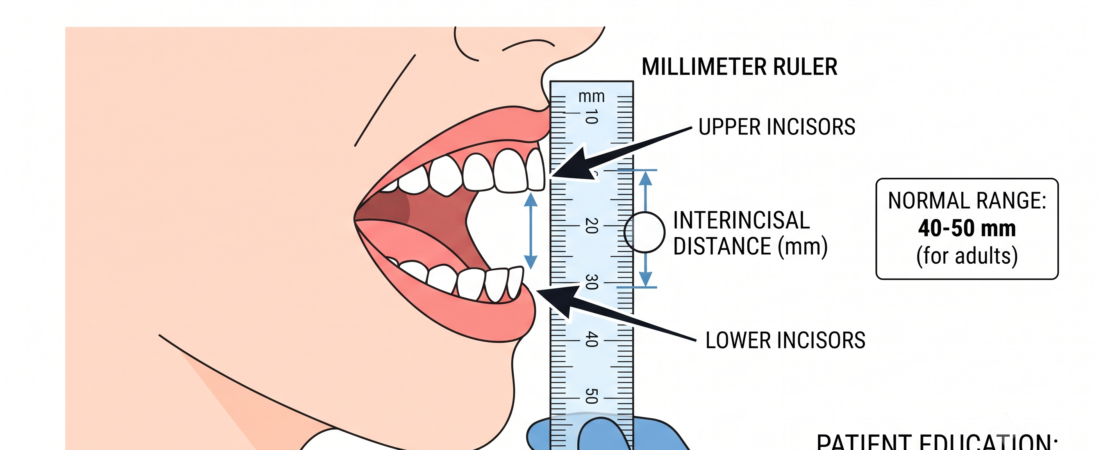
The standard measurement is maximal interincisal opening (MIO) — the distance between the biting edge of your upper front teeth and the biting edge of your lower front teeth, when your mouth is open as wide as it will comfortably go.
- Normal adult range: roughly 40–60 mm. Men are typically a little higher than women.
- Trismus: 35 mm or less. This is the internationally accepted cut-off (the Dijkstra criterion) used in research and clinics worldwide.
- Severely restricted: below 20 mm. At this level dental care, eating and even clinical examination for recurrence become very difficult.
As a rough reference, most people can fit three of their own fingers stacked vertically between their front teeth. Two fingers or fewer is a strong signal to measure properly.
If you have no front teeth or wear dentures: measure between the gum ridges instead, remove the dentures first, and write down that this is how you measured. What matters is that you measure the same way every time. Consistency beats precision.
How to measure at home
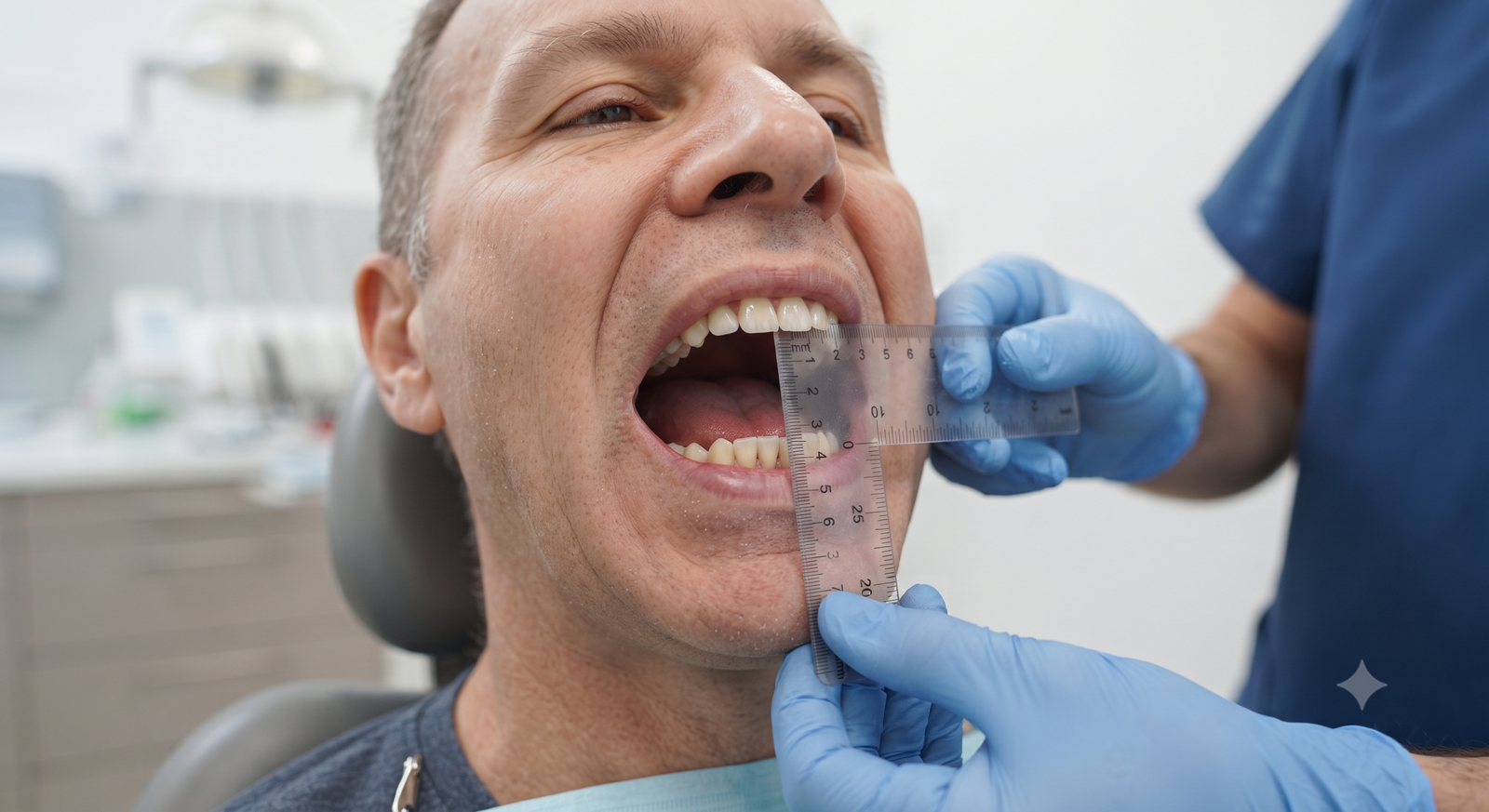
You need a ruler with millimetre markings. A steel ruler works; a plastic school ruler works.
- Sit upright in good light, in front of a mirror.
- Open your mouth as wide as you comfortably can. Comfortably. This is a measurement, not a stretch — do not force it.
- Hold the ruler vertically against your front teeth and read the distance from the edge of the upper incisor to the edge of the lower incisor.
- Take three readings and record the largest.
- Write down the number and the date.
A family member can do this more accurately than you can do it yourself. If reading the ruler in a mirror is awkward, mark the position with your thumbnail and read it afterwards.
Building your record
Measure once a week, on the same day, at roughly the same time — jaw mobility is often slightly better later in the day than first thing in the morning.
Keep a simple record:
- 6 Aug — 28 mm — pain on right side
- 13 Aug — 29 mm
- 20 Aug — 29 mm
- 27 Aug — 31 mm — easier chewing
This little table does three jobs. It tells you whether you are improving, holding, or losing ground. It gives your therapist a baseline that opinion cannot provide. And it protects you from the most common reason patients abandon their exercises — the feeling that nothing is happening. Progress in trismus is measured in millimetres over weeks. Without a record it feels like failure even when it is working.
Bring this record to every appointment. It is the most valuable thing you can carry into the clinic.
Part 2: Before you stretch — five situations that need a clinician first
Stretching is safe for most patients. It is not safe for all of them, and this section matters more than the exercises.
Do not begin a home stretching programme without clinical clearance if any of the following apply:
- Your mouth opening was stable and has suddenly become worse. New or rapidly worsening trismus in someone treated for cancer must be assessed. It can indicate recurrence. Please do not treat this as an exercise problem — see your oncologist or surgeon.
- You have pain, swelling, exposed bone, a bad taste or discharge in the jaw area, or a loose tooth in the irradiated region. These raise the possibility of osteoradionecrosis, where irradiated bone fails to heal. Forcing a stretch here can cause serious harm, including fracture.
- You have had recent surgery, a flap reconstruction, or a bone graft. Your surgeon sets the timing and the limits.
- You have severe mucositis during active treatment. Gentle movement is usually still appropriate, but the programme needs adjusting rather than pushing through.
- You have numbness, new facial weakness, or unexplained neck lumps. Get assessed first.
And one universal rule: stretching should feel like a firm pull, never a sharp pain. Sharp pain means stop.
Part 3: The exercises
The governing principle
Fibrotic tissue lengthens under gentle, sustained load repeated often — not under force. A hard, painful yank does not lengthen the tissue; it inflames it, and inflammation lays down more scar. Patients who stretch aggressively usually do worse than patients who stretch gently and consistently.
Frequency beats intensity. Every time.
Level 1 — Active jaw movement (warm-up, 2 minutes)
Do this before stretching. A warm jaw stretches better. A warm flannel held against the cheeks for a few minutes beforehand helps too, unless your skin is still fragile from radiation.
- Open and close slowly, within comfort — 10 times
- Move the jaw gently side to side — 10 each way
- Move the jaw gently forward and back — 10 times
- Slow, wide chewing motion — 10 circles each direction
Level 2 — Finger stretch (no equipment)
Place your thumb on your upper front teeth and your index finger on your lower front teeth, in a scissor position. Apply gentle, steady pressure to open a little wider than your comfortable maximum. Hold. Release slowly.
Useful when you have nothing else to hand. Least effective of the three levels.
Level 3 — Stacked tongue depressors (the practical home method)
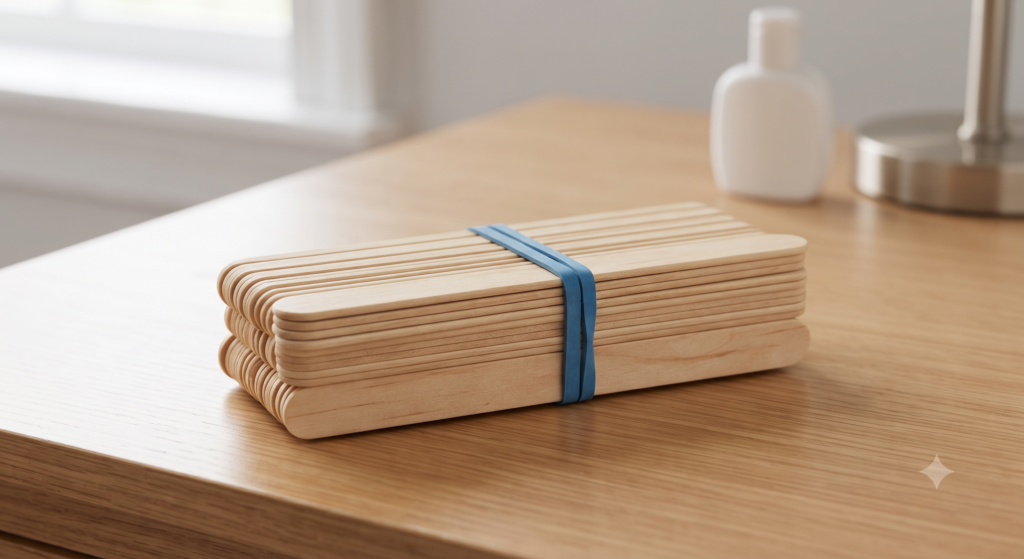
This is the workhorse of home trismus therapy in India — cheap, available at any chemist, and considerably more effective than movement alone.
- Stack wooden tongue depressors (ice-cream sticks work) into a bundle.
- Insert the stack between your front teeth — vertically, edge-on.
- Add depressors one at a time until you feel a firm stretch without pain.
- Hold the stretch for 30 seconds.
- Remove, rest 10 seconds, repeat 5 times.
- Do this 5 times a day.
Add a single depressor only when the current stack has stopped producing any stretch sensation. Adding two at once is how people injure themselves.
Published protocols vary — anywhere from 15 seconds to a minute, three to eight repetitions, several times daily. There is no single proven regimen. What the evidence is clear about is that consistency over months determines the outcome far more than the exact numbers.
Level 4 — Jaw mobilisation devices
Purpose-built devices (TheraBite, Dynasplint, Restorabite and similar systems) apply a controlled, measurable load and outperform simpler methods. In one comparative study, active movement alone produced an average gain of about 4 mm, tongue depressors about 6 mm, and a jaw mobilisation device about 14 mm.
They are expensive and not easily available in India. We assess whether one is justified in your case, and we can often arrange access or a suitable substitute. For many patients, disciplined tongue-depressor work is entirely adequate.
Part 4: What to expect
- Gains are slow. Typical improvement in published series is around 5–8 mm over two to three months of consistent work. If you gain 1 mm in a fortnight, that is a good fortnight.
- Some patients gain little — and the exercise still matters. In advanced fibrosis, holding your current opening steady while the underlying disease process pushes the other way is a genuine clinical success. Doing nothing is not a neutral option here.
- Progress is not linear. Plateaus of several weeks are normal. Intercurrent illness, dental problems and fatigue all set it back temporarily.
- This does not end. Once you have reached a functional opening, the exercises reduce — but they do not stop. Radiation fibrosis is lifelong. A maintenance programme of once or twice daily protects what you have gained. Patients who stop entirely usually return to us having lost most of it.
- Adherence is the real battle. In one study of 135 patients, only about two-thirds stretched as prescribed during the programme, and just over half were still doing so six months later. If you are struggling to keep up, that is normal and it is a solvable problem — tell us rather than quietly stopping.
Practical tips that improve adherence
- Attach it to existing routines — after morning tea, after lunch, after evening tea, before bed. Fixed anchors work better than “five times a day” in the abstract.
- Set phone alarms for the first month.
- Keep the depressors visible — on the dining table, not in a drawer.
- Do it while doing something else — the television, a phone call on speaker.
- Involve one family member. Patients supported by someone who asks about it daily do measurably better.
Many patients find these routines easier to sustain with structured occupational therapy support alongside their home programme.
Part 5: When to come in
Contact us for an assessment if:
- Your opening is 35 mm or less
- Your opening has reduced since your last measurement
- You have been stretching consistently for six weeks with no gain
- You cannot manage your own dental hygiene at the back of the mouth
- You are avoiding foods or social meals
And contact your oncologist or surgeon urgently — not us — if there is sudden worsening, new pain, swelling, exposed bone, a loose tooth in the irradiated area, or new numbness.
Trismus that has been present for a year is harder to treat than trismus present for a month, but it is not untreatable. Established fibrosis responds more slowly, not never. The worst decision available is to wait another six months to see whether it settles by itself. It will not.
If you are also noticing swallowing difficulty after treatment, mention it when you book — it is assessed separately but often overlaps with trismus care.
Frequently asked questions
How do I know if I have trismus after radiotherapy?
Measure. A maximal interincisal opening of 35 mm or less meets the accepted clinical definition. If you can stack fewer than three fingers between your front teeth, measure with a ruler properly.
Is it too late if my radiotherapy finished two years ago?
No. Late trismus responds more slowly than early trismus but it does respond. Start measuring this week, and get assessed.
How long until I see improvement?
Expect the first measurable change at four to six weeks of consistent daily work. Most gains accumulate over three to six months.
Does it hurt?
There should be a firm pulling sensation, not sharp pain. Some ache afterwards is acceptable; pain that persists into the next day means you stretched too hard.
Can I use chewing gum instead?
Chewing gum exercises the closing muscles, not the opening range, and can aggravate jaw joint pain. It is not a substitute for stretching.
I have dentures. Can I still do this?
Yes. Remove them, measure gum ridge to gum ridge, and stretch with the depressors placed against the ridges. Tell us — the technique needs adapting.
Will stretching break my jaw?
Gentle stretching within comfort will not. Forced stretching in an irradiated jaw, or in the presence of osteoradionecrosis, carries a real risk of fracture. This is precisely why the warnings above matter and why an assessment before starting is worthwhile.
Book a trismus assessment in Faridabad
We measure your opening in millimetres, examine the jaw and surrounding tissue, identify what is actually restricting it, provide hands-on myofascial and mobilisation therapy, and build a home programme you can realistically sustain — with re-measurement at every visit.
Trismus is one part of a wider recovery. If you are also managing swallowing difficulty after treatment, shoulder weakness after neck dissection, or neck swelling, our full oral cancer rehabilitation programme addresses these together rather than one at a time.
Hitesh(H)-HEALS Physiotherapy, OT & Cancer Rehab Centre
Ground Floor, Gate No. 4, B-1032, Opposite Gandhi Park, near NHPC Chowk, Greenfield Colony Block B, Sector 43, Faridabad, Haryana 121010
📞 +91 98119 55231 | 💬 WhatsApp us | ✉️ hhealsphysio@gmail.com
🕐 Monday–Saturday, 10:00 AM–2:00 PM & 4:00 PM–8:00 PM
Serving Faridabad — Sector 43, Greenfield Colony, NHPC Chowk, Old Faridabad, Ballabgarh, Neelam Chowk, Surajkund — and South Delhi and greater NCR.
Medical disclaimer: This article is general information and does not replace individual clinical assessment. Jaw stretching after radiotherapy carries specific risks in some patients. Please be assessed by a qualified clinician, in coordination with your oncologist or surgeon, before beginning a home programme.
Clinical references: Dijkstra et al., criteria for trismus in head and neck oncology (35 mm cut-off); Kamstra et al., systematic review of exercise therapy for trismus; Buchbinder et al., comparison of stretching modalities; Charters et al., exercise adherence in trismus after head and neck cancer treatment.
About the Author
Dr. Hitesh Gupta is a Consultant Occupational Therapist and Dysphagia Rehabilitation Specialist, and founder of Hitesh(H)-HEALS Physiotherapy, OT & Cancer Rehab Centre in Sector 43, Faridabad. He specialises in rehabilitation after head and neck cancer treatment. Read full profile →